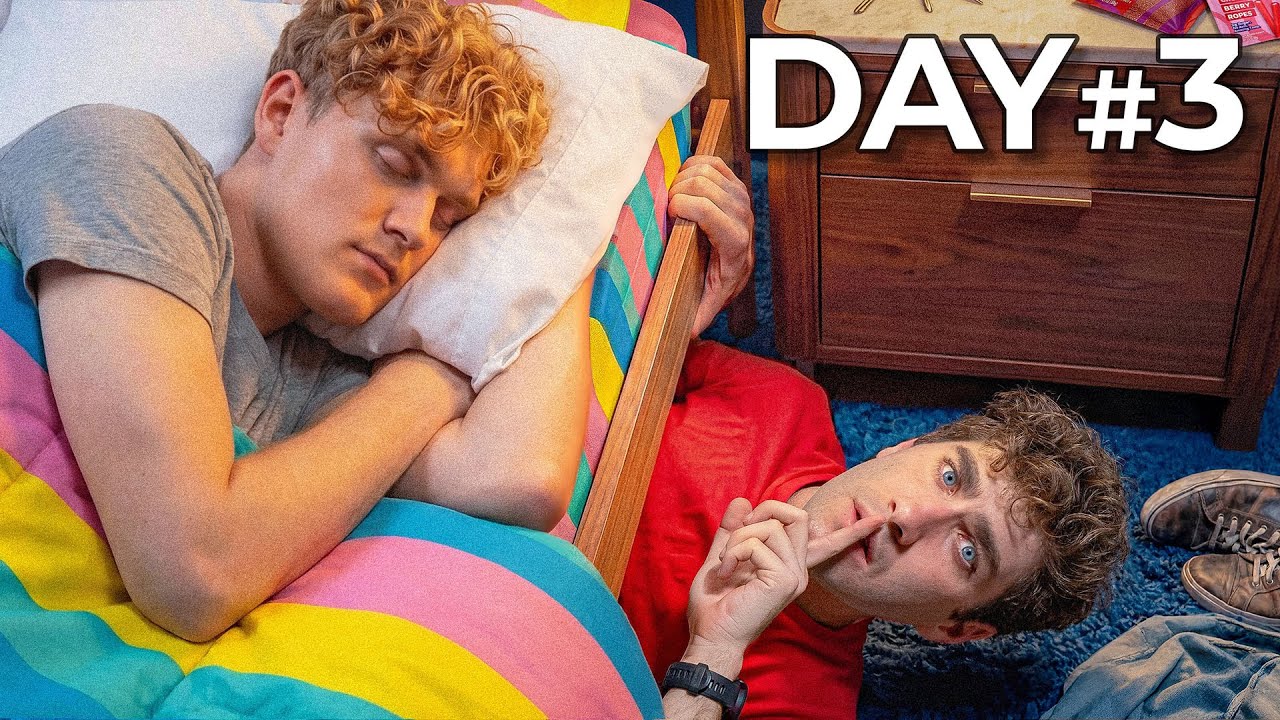
I Secretly Lived In Ryan Trahan's House
By Airrack · Entertainment · 5.2M views · 32:19
The teardown in brief
What's working
- **Premise clarity is immediate**: Within 10 seconds, viewers understand the entire concept — 'secretly living in famous YouTubers' houses without getting caught.' No confusion, no slow build. The hook delivers exactly what the packaging promises.
- **Surveillance footage innovation**: The use of hidden cameras and iPad monitoring creates a unique viewer experience. We see BOTH the creator's perspective and Mark Rober's surveillance view simultaneously. This dual-perspective approach is visually engaging and reinforces the stealth stakes.
- **Authentic close-call moments**: Several genuine near-catches (security confrontation at 24:00, person walking nearby at 8:25) create real tension. The creator's reactions feel unscripted and the situations unpredictable, which justifies the 32-minute runtime.
What's costing attention
- **Mechanical repetition kills novelty**: All three house sections follow the EXACT same structural beats — arrive, find spot, get food, hide overnight, leave prank. By Act 3, the format is so predictable that viewers are ahead of the creator. Each house needs distinct challenges or escalating stakes to justify its inclusion.
- **Relentless audio energy creates fatigue**: 59% of the video is delivered at shouting intensity (-4.8 to -11dB), 38% at loud excitement. Only 3% uses normal conversational tone. For 32 minutes, there's almost no dynamic range. Even high-energy challenge audiences benefit from pacing contrast — the constant intensity becomes white noise.
- **The fake-out catch breaks trust**: Getting 'caught' by Mark Rober at 2:00, playing it as genuine failure for 60 seconds, then revealing it was a setup — this trains viewers that the stakes aren't real. It's a retention cliff disguised as a twist.
The first 30 seconds
This is Ryan Treyan, and he has no idea that I've been secretly living in his home. Because I've always wondered, could you live in famous YouTuber houses without them even knowing? To find out, I'm going to three of the biggest YouTubers' houses with one goal. Survive the night without getting caught. >> Hey, it's act
Strong Tier 1 packaging delivery. The premise fires at 5 seconds ('he has no idea I've been secretly living in his home'), the concept is fully explained by 22 seconds ('three biggest YouTubers' houses... survive the night without getting caught'), and the first close-call moment appears at 20 seconds ('hey it's actually terrifying'). The hook immediately reaffirms what the thumbnail/title promised — no bait, no confusion. Viewers who clicked for stealth challenge content see exactly that within 10 seconds. Predicted 30s retention: 83%, placing this at the high end of the Tier 1 range.
Where viewers drop
1:59 — Fake-Out Catch (critical)
At 1:59, Mark Rober walks in and catches the creator eating lunch. The premise — 'secretly living without getting caught' — appears to collapse immediately. For 60 seconds, the video plays this as a real failure ('I let my guard down... caught me in the first hour... do I just go home?'). Then it reveals this was a fake-out and the real mission is moving to Mark's house. Viewers who came for stealth tension feel baited. The fake defeat breaks the trust contract.
Why it matters — This is a retention cliff. Viewers clicked for 'will he get caught?' tension. When the catch happens 2 minutes in, a chunk of the audience assumes the video failed and leaves. The recovery ('or so he thought') salvages some viewers, but damage is done. You've trained them that the stakes aren't real.
9:01 — Directionless Middle (moderate)
Between 9:00 and 12:00 in the Dude Perfect warehouse, the creator wanders through rooms, hides under a desk, sneaks around, but there's no clear goal or tension building. We watch him get food, sit in a closet, react to people nearby, but nothing happens. No close calls with real stakes, no progress toward 'surviving the night,' no payoffs. It's 3 minutes of filler between beats.
Why it matters — For a high-energy challenge audience, 3 minutes of aimless sneaking feels like dead time. The 'hiding under the desk' moment at 8:00-9:00 promises tension ('people walking in just feet away') but then nothing happens. The payoff never comes. Viewers start wondering when the actual challenge begins.
18:47 — Third-House Fatigue (moderate)
By the time we reach Ryan Trahan's mall at 18:47, the video has already completed two full cycles of the exact same pattern: arrive → sneak in → find food → find sleeping spot → leave prank. Now we're doing it a third time. The structure is so predictable that viewers are ahead of the creator. 'Oh, he'll wander around, find a Sbarro, hide in a bathroom, probably sleep in a cardboard box.' The novelty is gone.
Why it matters — Repetition is the #1 retention killer in long-form YouTube (per the empirical benchmarks). Even though each location is different, the mechanical pattern is identical. By Act 3, viewers feel like they're re-watching the same video. The mall section needs to break the formula to justify its existence.
0:00 — Relentless Energy Monotony (mild)
The audio energy data shows 59% of the video is shouting (-4.8 to -11dB) and 38% is loud excited delivery (-11 to -18dB). Only 3% is normal conversational tone. For 32 consecutive minutes, the creator maintains near-constant high intensity. There are no calm strategic moments, no reflective beats, no breathing room. Even the 'sleeping' sections are delivered at high energy. It's exhausting.
Why it matters — For a high-energy challenge audience, this pacing is mostly appropriate — they expect intensity. But even gaming/challenge content benefits from dynamic range. The few moments where energy dips (10:12-10:18 at -20dB, 25:51-26:12 at -19dB) feel like relief. Without contrast, the 'exciting' moments don't feel exciting — they're just the baseline. By minute 25, shouting is white noise.
How the video is built
- 0:00 Act 1: Mark Rober's Warehouse & Home — Establish concept with first challenge. Get 'caught' at warehouse (fake-out), then successfully infiltrate Mark's actual home and spend the night. Leave cardboard cutout prank.
- 6:05 Act 2: Dude Perfect's Warehouse — Second house with escalated difficulty (more people, more cameras). Use disguise, hide on warehouse shelves, successfully survive the night. Leave cutout prank video message.
- 18:47 Act 3: Ryan Trahan's Mall — Third and final house. Navigate public mall space, avoid security, build cardboard shelter inside Ryan's store, sleep 6 feet from him, make breakfast, leave note prank. Mission complete.
What any creator can steal
- The Mark Rober fake-out 'catch' at 2:00 breaks the premise contract
- Structural repetition makes the third house (Ryan's mall) feel like filler
- The middle 3 minutes at Dude Perfect (9:00-12:00) drags with no clear goal
- Audio energy is relentlessly high for 32 minutes with no dynamic range
- Sponsor integration at 11:05 interrupts peak tension in the Dude Perfect section
- **Build an escalation ladder into your concept from the start**: This video's fatal flaw is that all three houses feel similarly difficult. For your next challenge series, design the concept with CLEAR escalation: easy → moderate → hard → nearly impossible. Each stage should be visibly harder than the last. Viewers need to FEEL the difficulty increasing to stay engaged through long runtimes. Right now, Mark's warehouse and Ryan's mall feel interchangeable in challenge level.
More teardowns from Airrack
- How Many Days Can I Secretly Live In a Grocery Store?
- I Secretly Hid In Beast Games!
- I Faked Being Ronaldo In Public
- I Hunted Down Real Scammers!
Want this on your own video?
Add your video's link and its retention graph from YouTube Studio, and Retti shows the moment viewers left and why. Your first review is free.
Run your free review