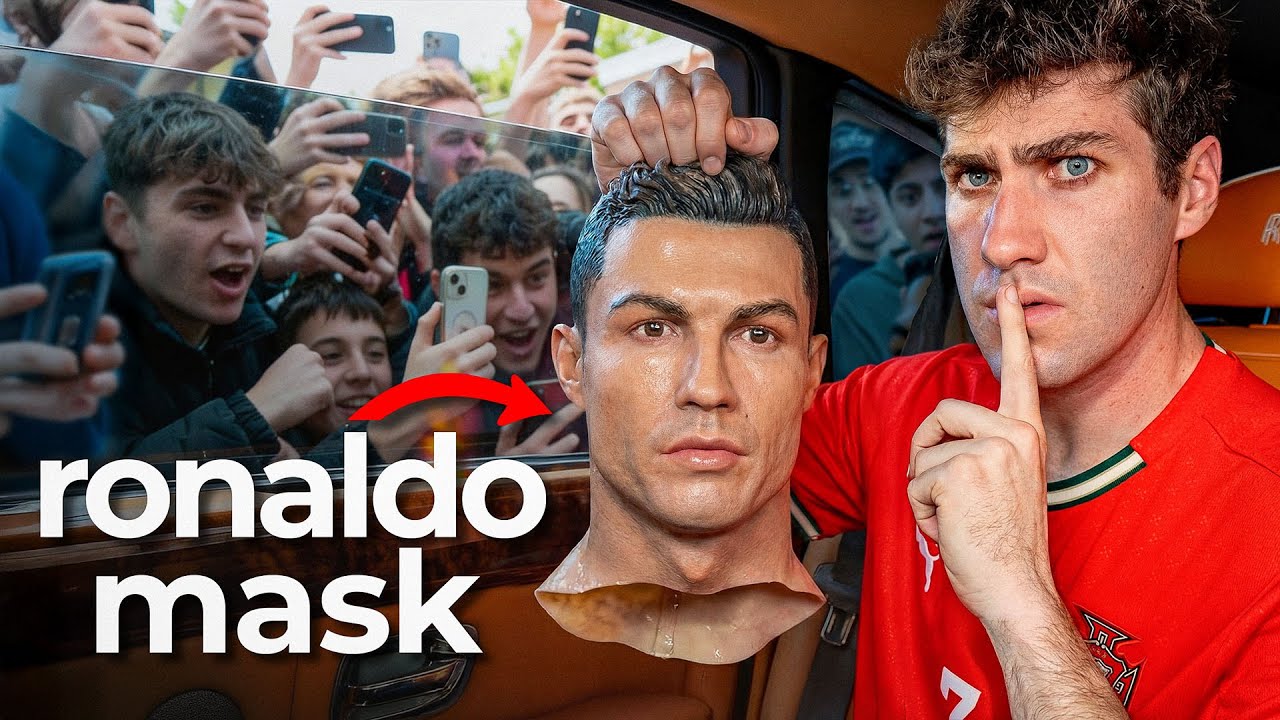
I Faked Being Ronaldo In Public
By Airrack · Entertainment · 7.9M views · 20:28
The teardown in brief
What's working
- The concept is immediately clear and inherently interesting — 'fool people with a celebrity disguise' has proven appeal, and Ronaldo as the target is a smart choice (globally famous, widely recognizable face)
- Escalating locations create a natural three-act structure with rising stakes — restaurant (intimate/controlled) → theme park (semi-public) → mall (full chaos). Each location is harder than the last, which sustains forward momentum
- Crowd reactions provide constant pattern interrupts and social proof — every time people swarm or security intervenes, it validates the premise and re-engages the viewer. These moments are gold.
What's costing attention
- The three locations follow mechanically identical patterns, which creates severe repetition fatigue by the mall sequence. Viewers can predict 'crowd builds → security arrives → escape' because they've seen it twice already
- Tyler skepticism is the emotional core but vanishes for long stretches (6+ minutes). Without regular stakes reminders, the video becomes 'watch a prank' instead of 'prove Tyler wrong', weakening investment
- Sponsor integration at 6:43-7:50 kills momentum at the worst possible moment — right when Universal is hitting peak intensity. The 70-second business pitch interrupts action and signals 'the good stuff is paused'
The first 30 seconds
This is me attempting to fool the public into believing that I'm actually Cristiano Ronaldo. And what happens next might shock you. Over the past 9 months, I've been crafting the greatest celebrity prank the world has ever seen. Disguised as the most famous man alive, Cristiano Ronaldo, I spent $20,000 to create the mo
Hook fires fast at 0:00-0:13 with clear concept reveal ('fool public into thinking I'm Ronaldo') and shock tease, which reaffirms the click. Strong start. But then 13s-46s is backstory overhead ($20k mask, Tyler skepticism, goal explanation) that delays clarity. The viewer understands WHAT (Ronaldo disguise prank) by 10 seconds, but doesn't know WHERE or HOW until 46 seconds. For high-energy prank content, this is acceptable but not optimal — you'd score Tier 1+ if the goal landed by 20 seconds.
Where viewers drop
1:38 — Mechanical Repetition Across Locations (critical)
The restaurant, Universal, and mall sequences follow the exact same pattern: arrive → crowd builds → security intervenes → escape. By the third location, viewers can predict every beat. The Universal sequence at 4:09-9:00 is nearly 5 minutes of 'crowd grows, security shows up' — then the mall at 10:18-19:39 is 9+ minutes of the same pattern repeated with minor variations. Once a viewer recognizes the formula, each repetition accelerates drop-off.
Why it matters — Repetition is the #1 retention killer across all YouTube content. Even viewers who love the concept will leave when they realize they're watching the same 5-minute loop for the third time. This creates compounding drop-off — the curve doesn't just decline, it accelerates with each repeated pattern.
6:43 — Sponsor Break Kills Momentum (critical)
Right when the Universal sequence hits peak intensity (crowd building, security involved, viewers invested), you cut to 70+ seconds of Whop sponsor content. The energy drops from crowd chaos to 'let me tell you about my business'. When you return at 7:50, you've lost the tension thread and have to rebuild it.
Why it matters — Sponsor breaks placed at peak moments are retention poison. Viewers came for Ronaldo pranks, not business pitches. At the 7-minute mark, you're still in the 'commitment audition' phase of a 20-minute video — viewers are deciding whether to invest 20 minutes. Interrupting peak action for an ad signals 'the good stuff is over' and causes a sharp drop.
3:22 — Stakes Forgotten for 6+ Minute Stretches (moderate)
You set up the Tyler skepticism as the core stakes at 0:35-0:46, then don't mention it again until the 3:22 phone call. After that call, Tyler vanishes again until 10:10. From 3:30 to 10:10 (nearly 7 minutes), the viewer forgets WHY they should care if the prank works — the Tyler bet is the emotional driver, but it's absent from Universal entirely.
Why it matters — In a 20-minute video, viewers need regular reminders of what's at stake. Without Tyler's disbelief as context, Universal becomes 'watching a guy fool people' instead of 'proving Tyler wrong'. The emotional investment weakens, and the action feels less meaningful.
0:00 — Slow Start — 46 Seconds Before Goal Clarity (moderate)
The first 13 seconds are strong (concept reveal + shock tease), but then 13s-46s is pure backstory: '$20k mask', 'Tyler thinks it will fail', 'find out if I can fool the world'. This is 33 seconds of setup that could be 10. The viewer already clicked knowing it's a Ronaldo disguise prank — they don't need the 'how we got here' story upfront.
Why it matters — For high-energy prank content targeting a young audience, hook tolerance is 5-10 seconds max. By 46 seconds, 15-20% of your audience is already gone — they want to see the prank, not hear about the planning. The commitment audition for a 20-minute video is the first 2-3 minutes, but the first 30 seconds still follow ultra-short attention rules.
How the video is built
- 0:00 Act 1: Restaurant Test (Controlled Environment) — Setup and first proof of concept. The Nou restaurant challenge establishes the mask works in an intimate, semi-controlled environment. Low stakes, high success. Ends with Tyler remaining skeptical.
- 3:45 Act 2: Universal Test (Public Chaos) — Escalation to a fully public environment with uncontrolled crowds. The prank succeeds TOO well — security intervenes, crowds swarm, they're forced to leave. Tyler still doubts it will work in a 'real' setting. Peak chaos but not the climax.
- 10:11 Act 3: Mall Test (Total Shutdown) — Final escalation and climax. The mall combines public exposure with deliberate crowd-building strategy. Multiple stores, police involvement, 'shutting down' the location. This is the ultimate proof. Ends with Tyler concession and victory lap.
What any creator can steal
- The three locations follow identical mechanics — by the mall, viewers can predict every beat
- Sponsor break at 6:43-7:50 kills Universal momentum at peak intensity
- Tyler skepticism vanishes for 6+ minutes during Universal — stakes forgotten
- Hook takes 46 seconds to state the goal — too slow for high-energy prank content
- Universal escape drags for 50 seconds after the tension peaks
- The repetition problem starts in pre-production. If you shoot three locations with the same plan ('walk in, let crowd react, leave'), you'll end up with repetitive footage. Instead, script different objectives: Location 1 = stealth test, Location 2 = duration test, Location 3 = deliberate chaos test. This forces you to capture different types of footage and prevents mechanical repetition.
More teardowns from Airrack
- How Many Days Can I Secretly Live In a Grocery Store?
- I Secretly Hid In Beast Games!
- I Hunted Down Real Scammers!
- I Secretly Lived In MrBeast's Theme Park
Want this on your own video?
Add your video's link and its retention graph from YouTube Studio, and Retti shows the moment viewers left and why. Your first review is free.
Run your free review