Why You Wouldn’t Survive Queen Elizabeth I’s Royal Feast (1570)
By Victorian Life · History · 171.1K views · 45:12
The teardown in brief
What's working
- The second-person immersive frame is exceptional — 'you are about to sit down' puts every viewer inside the experience rather than observing from outside, which is rare and effective in documentary content
- The danger-inside-beauty pattern is deployed consistently and never feels repetitive because each reveal targets a different category — tableware, food safety, dental health, social catastrophe, waterborne illness — escalating in intimacy
- The writing has genuine literary quality: 'this was what it actually smelled like to be powerful in 1570' earns a hold because it reframes the entire experience in one sentence
What's costing attention
- CTA placements at 2:09 and 15:16 interrupt narrative momentum at precisely the moments when the forward pull is strongest — a documentary of this quality deserves better CTA placement strategy
- The Galenic medicine section drops the second-person frame entirely for over two minutes, breaking the immersive contract the hook established with the viewer
- Stakes are primarily intellectual and retrospective — the 'you will die slowly from this' frame is effective but never escalates or sharpens; the same danger-level persists throughout rather than building to a single most-alarming revelation
The first 30 seconds
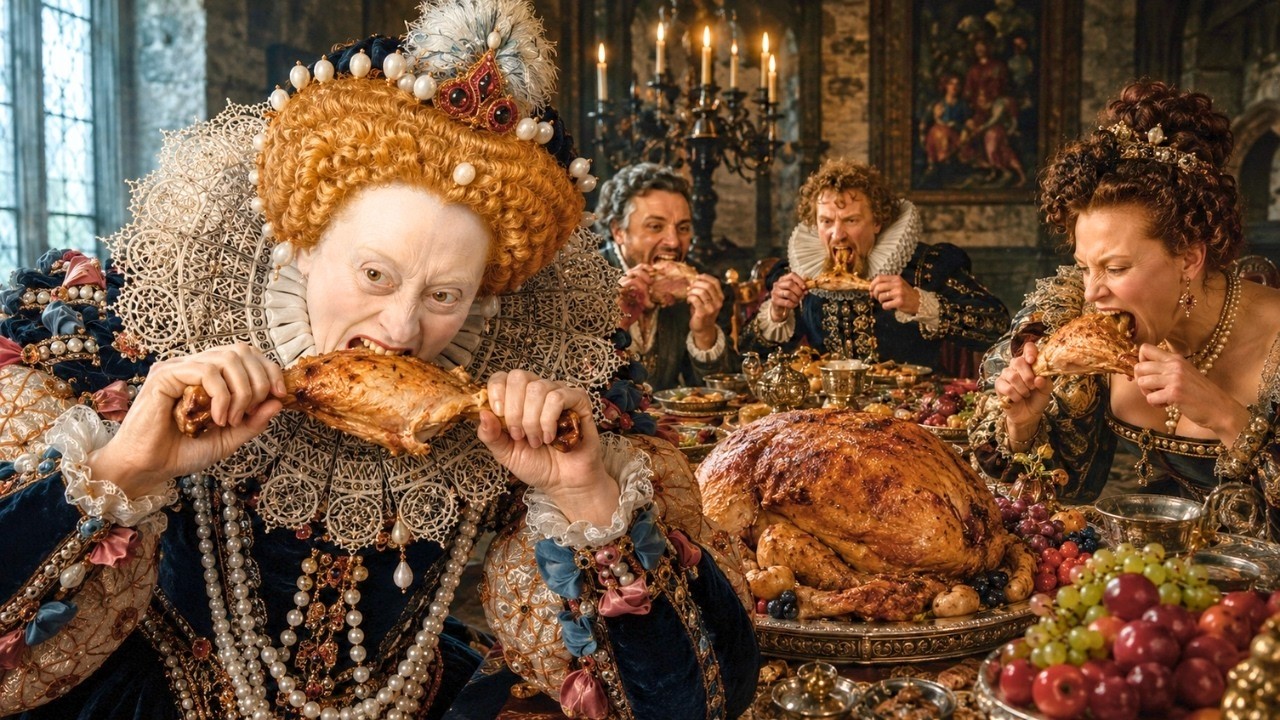
You are about to sit down at the most spectacular dinner table in the entire Western world. The hall is dazzling. The candles are blazing. The smell of roasted venison and cinnamon and rosewater fills the air so thickly you can almost taste it before a single dish has touched your lips. Around you, the most powerful me
One of the cleanest documentary hooks in this niche — the second-person immersive frame fires immediately, the feast setting is established within 4 seconds, and the survival premise is explicit by 1:07. Viewers who clicked for 'Elizabethan feast' receive exactly what the title promised within the first few sentences.
Where viewers drop
2:10 — Mid-Hook CTA Interrupt (critical)
Just as the hook reaches its most compelling promise — 'here is the part nobody tells you before they send you through the palace gates' — the video stops cold for a subscribe/like/comment ask lasting about 13 seconds. You've been pulled into one of the most immersive openings in this niche and then someone rings a bell and asks you to do homework.
Why it matters — The viewer's curiosity is at its highest point precisely here — the hook has promised dangerous secrets. Breaking it to ask for engagement before delivering a single revelation trains the viewer's hand toward the back button.
15:15 — Mid-Revelation CTA Break (moderate)
At 15:16, right after establishing that the lead in the pewter cup 'would be the least dramatic of the many things this meal would quietly do to your body' — a genuinely gripping forward tease — the video pauses for a like request before pivoting to the etiquette section. That forward tease goes cold for about 9 seconds.
Why it matters — The narrator just told the viewer that lead poisoning is the LEAST of their problems. That's a strong open loop demanding immediate payoff. Stopping to ask for a like severs the tension at its tightest point.
24:27 — Galenic Theory Abstract Plateau (moderate)
From roughly 24:28 to 27:00, the video shifts into an explanation of Galenic humoral theory — blood, phlegm, yellow bile, black bile — with no concrete danger payoff and no second-person address. The 'you at the feast' frame that has driven the whole video disappears for over two minutes of theoretical medical history.
Why it matters — The viewer clicked for danger and sensory experience. Abstract medical philosophy without a 'this is what it means for your body tonight' anchor feels like a detour. The section recovers at 26:09 when the narrator acknowledges that some of it accidentally worked — but the entry into the theory loses the immersive frame for too long.
41:43 — Extended Outro and Final CTA Sequence (mild)
The video's emotional climax — 'the danger was real, the wonder was also real, and in this room in 1570 they cannot be separated from each other' — arrives around 41:34. What follows is roughly three and a half minutes of CTA ask, then a philosophical epilogue about the feast as a power machine, then a closing narrative, then a final outro. That's a long wind-down after the emotional peak has already landed.
Why it matters — Viewers who have invested 41 minutes in an immersive experience will feel the peak arrive and begin drifting. The epilogue material is genuinely excellent — the 'feast as technology' framing is the video's sharpest intellectual insight — but it arrives after what feels like the emotional resolution, making it feel like a bonus chapter the viewer wasn't told to expect.
How the video is built
- 0:00 The Invitation — Immersive Hook and Stakes — Second-person present-tense setup drops the viewer into Hampton Court. The promise: this spectacular feast is also quietly killing everyone in the room.
- 2:25 The Setting — Court, Palace, and Hierarchy as Context — Historical grounding in 1570 Elizabeth, the spatial hierarchy of the Tudor court, and the sensory experience of the palace itself.
- 7:45 The Dangers — Serial Revelation of Hidden Threats — The core of the video: kitchen conditions → food poisoning → food itself → pewter/lead → etiquette minefield → sugar/teeth → Galenic medicine → Tudor diet → alcohol culture → Queen's dining ritual → the noise. Each section reveals a new category of danger using the same 'beautiful but deadly' pattern.
- 38:20 The Resolution — Survival, Resilience, and the Feast as Machine — Modern nutritional assessment of the feast, the body's resilience, the sensory emotional close, and the intellectual thesis: the feast was a deliberately designed technology for producing social order.
What any creator can steal
- Move the 2:09 CTA — it kills your best hook
- Re-anchor the Galenic medicine section to the viewer at the table
- Add a stakes escalation arc across the danger sections
- Restructure the final 3.5 minutes to protect the emotional peak
- Add a forward bridge at each major section transition
- Plan your CTA placements before scripting, not after. In a documentary like this, CTAs belong at chapter transitions where the viewer has just received a payoff and is taking a breath — not in the middle of an open loop or at the hook's peak tension point.
Want this on your own video?
Paste any YouTube URL and Retti maps every drop, spike and plateau to the moment that caused it.
Analyse a video free