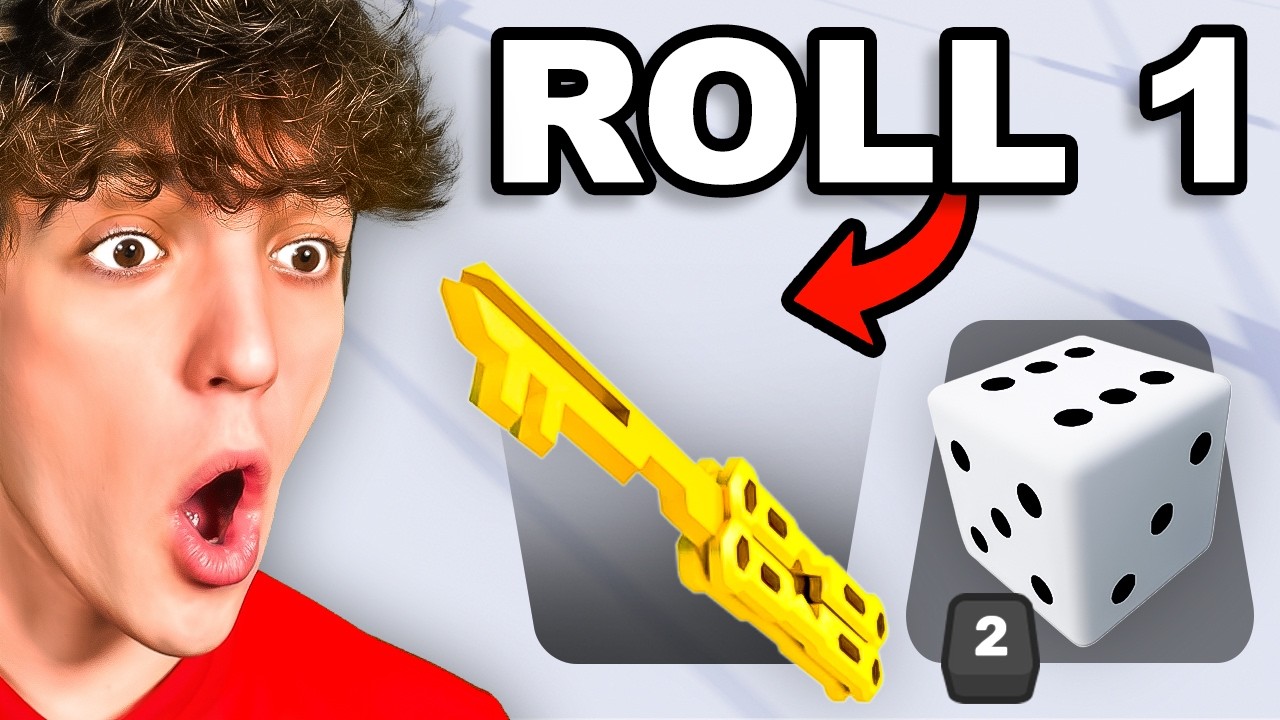
Rivals RNG, But I Can Only ROLL ONCE... (again)
By KAYE · Gaming · 202.8K views · 17:51
The teardown in brief
What's working
- The weapon RNG mismatch generates genuine comedic tension — moments like katana vs medkit or warp stone vs katana are inherently funny and unpredictable, which keeps the format feeling fresh across multiple rounds
- The 100k Robux stakes are specific and believable — a real number with a real consequence makes every round matter more than a purely pride-based challenge would
- The banter between the two players feels authentic and natural — the back-and-forth trash talk has genuine chemistry that makes even losing rounds entertaining
What's costing attention
- The score system is never clearly explained on screen — viewers lose track of the series state for minutes at a time, which kills the tension that the stakes should be generating
- The series callback opening filters out new viewers before the concept even lands — any cold-traffic viewer starts with a mild disadvantage
- The final outcome is decided by game RNG rather than player skill or a dramatic last-round weapon matchup, which underdelivers relative to the 17-minute buildup
The first 30 seconds
Hello. 2 months ago, I did this video called Rivals RNG, but we only get one roll. And you guys really liked it. So, today I'm writing it back and I invited my friend Slurpee, and we're going to be playing Rivals RNG, but we can only roll once. >> Wait, so if I get a freaking flare gun, I have to use it. >> Yeah, exact
The concept lands by 11 seconds when Slurpee asks about the flare gun rule, but the opening 7 words ('Hello. 2 months ago, I did this video') are a series callback that tells new viewers they missed something — that's a Tier 2 delivery because it creates mild confusion about whether they need prior context before the format is established.
Where viewers drop
0:00 — Series Callback Opening (moderate)
The video opens with '2 months ago, I did this video called Rivals RNG, but we only get one roll. And you guys really liked it.' Any viewer who hasn't seen the original — which is most cold-traffic viewers — immediately feels like they walked into an inside joke. The first 7 words are about a video they haven't seen.
Why it matters — Casual viewers or new subscribers don't feel like this was made for them. It signals 'returning fans only' before the actual concept even lands, costing you the algorithmic cold-traffic audience that any recommender push would deliver.
2:00 — Score Tracking Confusion (moderate)
Throughout the video the score is called out in two different systems — per-map sub-scores ('5 to 4,' '4 to 1') and the overall series score ('one to one,' 'two to two') — without clearly labelling which is which. At 5:00 the creator shouts 'five to one' and then immediately says 'that means the score I've caught up is one to one.' A viewer who just tuned in has no idea what either number means.
Why it matters — In challenge content, score clarity IS tension. If the viewer can't track the score at a glance, they can't feel the stakes rising. The 100k Robux prize loses urgency every time the math gets murky.
7:10 — Stakes Forgotten in Mid-Game (mild)
The 100,000 Robux stakes are announced at 0:24, mentioned again at 4:26, and then go quiet for roughly 6 minutes (4:30 to ~9:19) while the gameplay continues. During this stretch — which covers the score going from tied to Slurpee leading 2-1 — the viewer has no reminder of why the outcome matters.
Why it matters — Six minutes is a long time for a young gaming audience to hold a number in their head without a nudge. The tension of the comeback at the 10-minute mark would hit harder if the viewer had just been reminded what's on the line.
15:58 — Anticlimactic RNG Ending (mild)
The deciding moment of the entire video — who gets 100,000 Robux — is resolved by Slurpee hiding in a smoke grenade and waiting out a timer that randomly assigns the point via game RNG. The creator literally yells 'IT ALL CAME DOWN TO RNG IN THE END' as the win is delivered. The whole final 2 minutes are two players shouting 'where are you' at each other with no weapon-based combat.
Why it matters — The format is built on weapon RNG as the core tension. Ending on timer RNG feels like the game decided the outcome instead of the players — which deflates the payoff. Viewers who watched 17 minutes for a satisfying conclusion get 'the game made a random choice' instead.
How the video is built
- 0:00 Setup and first map
- 4:25 Second map — score tightens
- 7:10 Third map — Slurpee takes lead
- 11:50 Fourth map — creator fights back to 2-2
- 14:00 Final deciding round
What any creator can steal
- Cut the sequel callback from the first sentence
- Add a visible score state every time the series score changes
- Add one stake reminder at the series-defining 2-1 moment around 9:15
- Reframe the RNG ending before the outro
- Clarify the accidental roll penalty ruling at 1:05
- Before filming, agree on one extra consequence that stacks on top of the Robux — something visible and embarrassing, like 'loser has to use the war horn as their main weapon for a full ranked session on camera.' This gives the video a second payoff beyond the money transfer and a built-in next-video concept.
More teardowns from KAYE
Want this on your own video?
Add your video's link and its retention graph from YouTube Studio, and Retti shows the moment viewers left and why. Your first review is free.
Run your free review