I Tested Japan's Weirdest Fast Food Items
By Dallin Hazard · Food · 360.3K views · 26:15
The teardown in brief
What's working
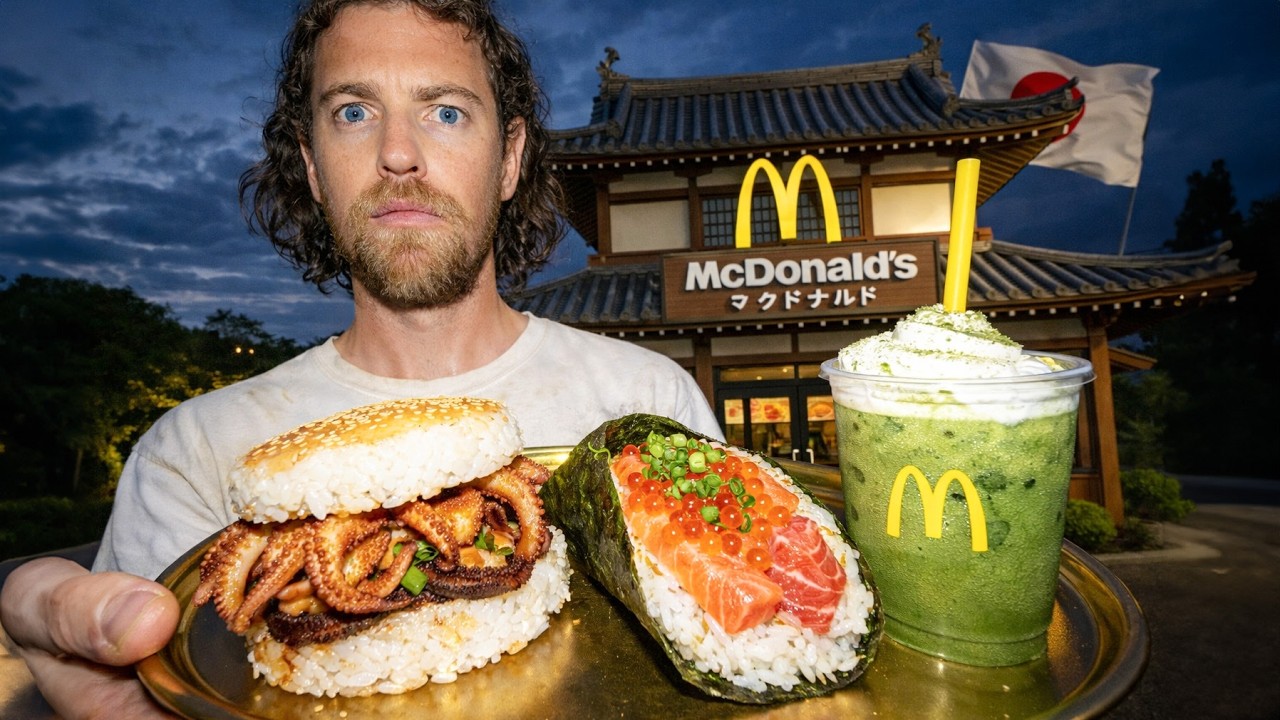
- The McDonald's segment (7:52–12:47) is genuinely excellent — the creator's authentic enthusiasm for the teriyaki burger ('that is the best McDonald's hamburger I've ever had') creates a real emotional peak that holds the curve. This is the video's standout moment and the reason the format works at all.
- The Krispy Kreme ordering roadblock — being told only glazed donuts are available before 10am — is a natural narrative complication that creates brief but effective tension. Unplanned real-world friction like this is gold in travel challenge content.
- The scoring system (taste + weirdness + bonus point) gives the video a competitive skeleton that most food travel videos lack. Even if the stakes need work, the structure creates implicit forward pull: who will win?
What's costing attention
- The prize is teased throughout but never specified until the end, and when revealed it's a Gotcha toy and $20 — a mismatch between the 'amazing prize' language used to hype it and what it actually is. Either specify the prize in the hook so viewers are invested, or make the small prize a self-aware punchline.
- The repetitive restaurant loop structure — identical format across all 7 stops — creates strong predictability by restaurant 3. There's no mechanical escalation, no accumulated stakes, and no single decision or failure that carries weight from one restaurant to the next.
- Audio energy never drops below LOUD for 26 minutes (51% shouting, 43% loud, 6% normal, 0% quiet). For a moderate-patience audience watching a 26-minute video, zero dynamic contrast creates listener fatigue that reads as monotony even when the content itself is different.
The first 30 seconds
I'm in Japan and apparently American fast food restaurants are so much better in Japan compared to the ones in the US. We literally invented fast food, so I don't know how that works. However, I have heard they have some really, really delicious food. They have some fun drinks and they have food that you can eat here t
Concept lands within 8 seconds and Japan fast food is clearly established, but 'the best one wins a prize — we'll get to that' is a deliberate delay that weakens the hook. Viewers who wanted specific stakes or restaurant names before committing don't get them in the first 30 seconds.
Where viewers drop
5:04 — Repetitive Restaurant Loop (critical)
For roughly 15 minutes straight, you cycle through the exact same pattern at Burger King, McDonald's, Taco Bell, KFC, and Panda Express: arrive, read menu aloud, order, taste each item, rate it. By the third restaurant most viewers can predict what's coming before you get there — and predictable formats bleed audiences fast.
Why it matters — When viewers can mentally complete the next 90 seconds before you say a word, they click away. You've got genuine standout moments buried in here — the McDonald's teriyaki burger reaction is legitimately great — but they keep getting diluted by the sameness of the wrapper around them.
16:41 — KFC Ordering Filler (moderate)
For about 29 seconds you're stuck in a back-and-forth with a staff member about the buzzer — 'I already got the buzzer, thank you' repeated three times, then navigating where to sit. No food, no information, nothing moving forward.
Why it matters — Viewers clicked to watch you eat weird fast food in Japan, not watch you navigate seating logistics. This is exactly the kind of dead moment that makes people check how much video is left.
19:45 — Panda Express Anticlimactic Segment (moderate)
You essentially walk up, say 'it's going to be the exact same,' order orange chicken anyway, eat it in five seconds, confirm it's the same, and give a 2/0 rating. This segment exists purely to fill the restaurant count and the viewer can feel that.
Why it matters — A segment that the creator clearly doesn't believe in telegraphs to the viewer that this stretch is skippable. You're essentially saying 'nothing interesting here' on camera — that's a viewer permission slip to leave.
25:13 — Underwhelming Prize Reveal Ending (moderate)
The prize has been teased throughout as 'amazing' and 'beautiful' — then the video reveals it's a Gotcha toy and 3,000 yen ($20). The transcript cuts off mid-reveal with no real payoff beat, no punchline, no emotional landing. The video just ends.
Why it matters — The prize has been a forward-pull thread through the whole video. When you finally cash it in and the payoff is 'a capsule toy and twenty bucks,' there's a deflation that makes the whole competition feel retroactively low-stakes. Viewers who stuck around for the finale feel cheated. The video needed either a bigger prize, or a self-aware joke that turns the small prize into the punchline.
How the video is built
- 0:00 Setup & First Restaurant — Hook establishes premise, competition framing, and prize tease. Krispy Kreme serves as the structural template for all subsequent restaurants.
- 5:03 Mid-Tier Restaurants — Burger King, McDonald's. The range from flat (BK) to exceptional (McDonald's) creates the video's strongest emotional arc. McDonald's is the clear peak.
- 12:49 Declining Returns — Taco Bell, KFC, Panda Express. Three consecutive restaurants with disappointments, confusion, and a near-throwaway final entry. Energy and stakes both wane.
- 20:42 Final Restaurant & Results — Wendy's delivers surprising menu variety and genuine enthusiasm. Winner revealed (McDonald's) and prize shown.
What any creator can steal
- State the prize AND the consequences in the first 30 seconds
- Cut the Panda Express segment entirely
- Add a forward bridge at every restaurant transition instead of backward wraps
- Cut the KFC buzzer/seating exchange completely
- Keep the competition framing alive mid-video with one callback line per restaurant
- Plan the competition stakes before you film, not after. Decide what happens to the winner AND the loser before you walk into the first restaurant. The prize, the penalty, the rule that makes each score matter — all of this needs to be in the hook. If you figure it out during filming, re-record the hook before you post.
More teardowns from Dallin Hazard
Want this on your own video?
Paste any YouTube URL and Retti maps every drop, spike and plateau to the moment that caused it.
Analyse a video free