I Ate The Most Unhealthy Item At EVERY Fast Food Chain
By MattDoesFitness · Food · 278K views · 22:56
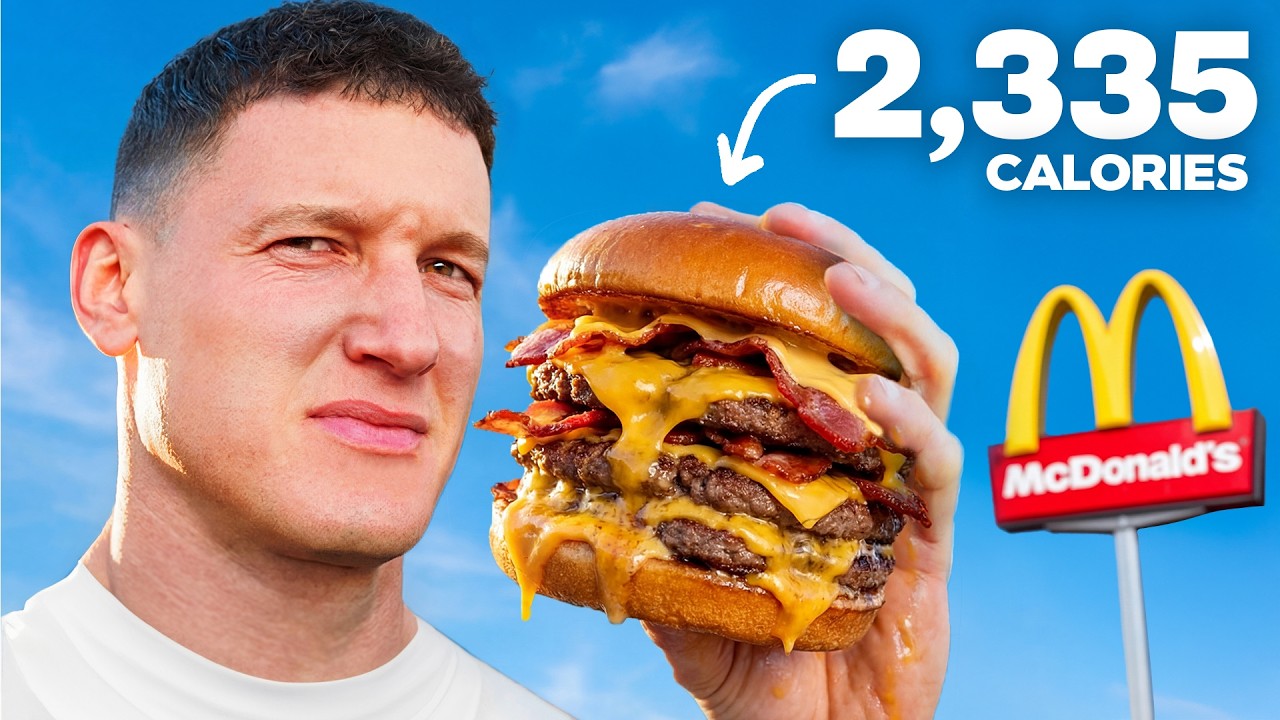
The teardown in brief
What's working
- Hook delivers fast (concept clear by 0:10, visual proof of calorie density at 0:02) and immediately reaffirms the click. The pizza bite opening is smart — it's the video's highest calorie bite, so starting with it creates curiosity about how you'll get there.
- The 'bite calorie' calculation at each restaurant is a clever mini-payoff that adds educational value beyond just listing numbers. Viewers get both the data AND the tangible comparison (walking time, bike riding, shadow boxing) that makes the calories feel real.
- Your on-camera personality and chemistry with your friend carry the repetitive structure better than it should work. The banter, reactions, and self-awareness ('I've eaten way too many fries today') keep the video watchable even when the format is predictable.
What's costing attention
- Mechanical repetition kills retention from restaurant #3 onward. You execute the EXACT same 7-step routine at all five locations with no variation. By Slim Chickens (8:30), the format is locked in and viewers know the next 14 minutes will follow the same pattern. Pattern recognition is a retention killer — once viewers can predict the whole video, they leave.
- No stakes or escalation beyond calorie numbers going up. There's no challenge, no time pressure, no physical consequence, no competition, no risk of failure. You're just collecting data across five locations. For a 23-minute LONG video, stakes persistence is critical — viewers forget why they're watching over longer timescales. You set the concept at 0:22 and never remind viewers why this matters.
- Two sponsor reads (8:47-9:31, 15:21-15:35) interrupt momentum at bad times. The Huel read comes right as you're starting restaurant #3 (the pattern fatigue zone), and the Gym Shark read drops mid-Five Guys. Both feel like hard stops rather than integrated content.
The first 30 seconds
How much damage can one bad meal really do? Well, one bite of this pizza contains nearly 200 calories. That's 10% of the average person's daily calories in one bite. So, the answer is quite a lot of damage. And today, I'm going to be visiting some of the UK's most popular fast food chains in search of the highest calor
Strong Tier 1 hook. Opens with the highest-impact moment (pizza bite = 200 calories, 10% of daily intake) which both proves the video's premise visually and creates a curiosity loop: where does that pizza come from? Concept is fully clear by 0:10 ('highest calorie meals at every chain'), visual proof lands at 0:02, stakes are light but present ('how much damage can one meal do'). The only micro-weakness: the first 2 seconds are slightly generic ('How much damage can one bad meal really do?') — if you opened directly ON the pizza visual at 0:00, the hook would fire even faster. But this is nitpicking a good hook.
Where viewers drop
9:41 — Repetition Fatigue — Restaurants 3-5 (critical)
You visit Slim Chickens, Five Guys, and Domino's using the EXACT same pattern you established at McDonald's and Burger King: order, reveal calories, taste, weigh bite, calculate, react. By restaurant #3, the viewer knows exactly what's coming every time. The novelty is gone. Even though the food changes and the calorie counts escalate, the viewing experience feels like watching the same scene on repeat. The Five Guys section (13:48-18:33) particularly drags because you spend nearly 5 minutes doing something the viewer has now seen four times already.
Why it matters — Repetition is the #1 retention killer on YouTube. Your transcript shows the same mechanical structure five times in 23 minutes. Viewers who recognize a pattern will skip ahead or leave entirely. Expected retention drop: 15-25% across this zone as pattern exhaustion sets in.
0:00 — Flat Stakes — No Escalation (major)
You set the concept in the first 30 seconds ('highest calorie meals at every chain') and then... just do it. There's no challenge, no time pressure, no physical consequence, no goal beyond 'eat and calculate.' The only escalation is the calorie numbers going up, but that's passive data, not story tension. By Five Guys (13:48), you're saying 'I feel sick' and 'I've eaten too many fries,' but that's just complaint, not stakes. The viewer never wonders 'will he make it' because there's nothing to make it TO.
Why it matters — Stakes create forward pull. Without them, a 23-minute video feels aimless even if it's entertaining moment-to-moment. Viewers who click for food challenge content expect JEOPARDY — will the creator finish? Will they regret it? Will something go wrong? This video is more like a documentary tour: informative but lacking narrative drive. For a LONG video (20-45 min), stakes reinforcement is CRITICAL — viewers forget why they're watching over longer timescales.
16:46 — Five Guys Fries Drag (moderate)
You spend 1 minute 47 seconds (17:12-18:59) complaining about the portion size of Five Guys fries. The jokes are repetitive: 'still so many fries,' 'the bag feels full,' 'too many fries,' 'I've been eating these forever,' 'you could come back in 2000 years and I'd still be here.' We get it after 30 seconds. The rest is filler. Viewers who are watching for food data or entertainment will check out here because you're stuck in one repetitive reaction.
Why it matters — This is non-progressive content — you're not advancing the video's premise, just expressing the same complaint six different ways. For a viewer who's already pattern-fatigued from three previous restaurants, this section confirms their suspicion that the video is dragging. Predicted drop: 6-10% across this section as viewers realize you're stalling.
8:48 — Sponsor Reads Break Momentum (moderate)
You insert a 44-second Huel ad (8:47-9:31) immediately after the Burger King section, just as you're about to go to Slim Chickens. Then a 14-second Gym Shark ad at 15:21-15:35 during Five Guys. Both feel like hard stops — the video's forward motion halts, you talk about a product, then resume. For viewers who are already dealing with repetitive structure, these breaks are exit points.
Why it matters — Sponsor reads in list/compilation videos are retention sinkholes because they interrupt the pattern the viewer came for. Predicted drop: 5-7% at each sponsor break. The Huel read is particularly risky because it comes right as the video is establishing its rhythm (restaurant #3 about to start).
How the video is built
- 0:00 Hook — Concept Establishment — Opens with highest calorie bite visual proof (pizza), states mission (highest calorie meal at every chain), establishes educational angle (calorie calculations)
- 0:31 McDonald's — Pattern Establishment — First restaurant visit establishes the 7-step routine: order, reveal calories, taste test, commentary, bite calculation, reaction, transition. This section teaches viewers the format they'll see repeated.
- 4:23 Burger King — Pattern Confirmation — Second restaurant follows identical structure. By the end of this section, viewers know exactly how the next 14 minutes will unfold.
- 9:41 Restaurants 3-5 — Repetition with Escalation — Slim Chickens, Five Guys, Domino's all follow the established pattern. Only variation is calorie numbers increasing and creator feeling progressively worse. Sponsor reads interrupt at 8:47 and 15:21.
- 22:27 Outro — Collapse and Exit — Creator admits defeat, can't finish Domino's meal, ends video. Classic challenge-failure ending but without the challenge setup earlier.
What any creator can steal
- The video's structure becomes fully predictable after restaurant #2 (4:51)
- Stakes are set at 0:22 ('which item should you avoid') and never reinforced
- You spend 1:47 (17:12-18:59) making the same 'too many fries' joke at Five Guys
- Two sponsor reads (8:47-9:31, 15:21-15:35) interrupt momentum at critical moments
- Your segment transitions use backward-wrap language instead of forward bridges
- Build in format variety from the start. If you're doing another multi-location video, plan for different approaches at each location BEFORE filming. Example: locations 1-2 get the full breakdown, location 3 is a speed challenge, location 4 is blind taste test, location 5 is the finale. Write this into your shot list so you're not trying to manufacture variety in the edit.
Want this on your own video?
Add your video's link and its retention graph from YouTube Studio, and Retti shows the moment viewers left and why. Your first review is free.
Run your free review